
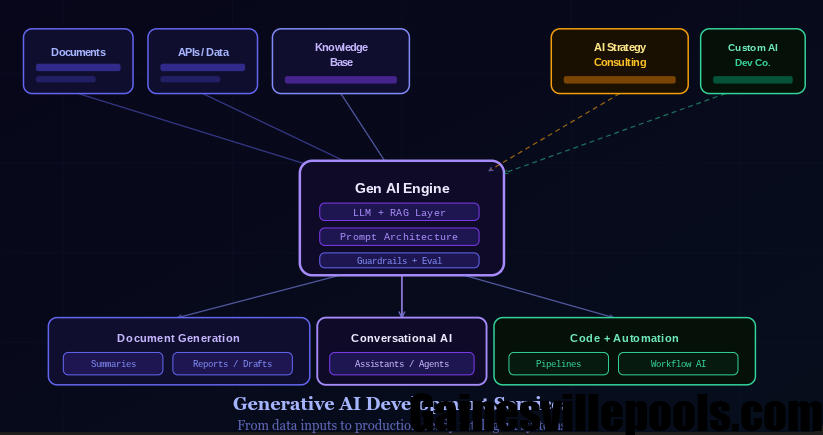
There is a moment most AI teams recognize. The demo runs well. The outputs look impressive. Leadership approves the next phase. And then the complexity of making that demo into a real product that performs reliably, integrates with existing systems, and earns genuine user trust begins to surface. This is the moment where generative AI development services either deliver or fall short. Choosing the right partner for that transition is one of the most consequential decisions a business will make in its AI journey.
What Generative AI Development Services Require in Practice
Generative AI development services cover considerably more ground than model selection. The model is one component in a system that includes data pipelines, retrieval architecture, prompt engineering, evaluation frameworks, integration layers, interface design, and monitoring infrastructure. All of these need to work together before a system is ready for production.
At BayOne, generative AI development services begin by establishing what the system needs to do in specific, measurable terms. This is not a design exercise. It is an engineering requirement, and vague goals produce vague systems. A document summarization tool built for a legal team needs to handle specific document types, produce outputs in a defined format, and meet latency requirements that make it usable within an existing workflow. Defining those requirements precisely is part of what separates generative AI development services that produce production systems from those that produce extended pilots.
AI Strategy Consulting as the Mandatory Starting Point
Generative AI development services without prior AI strategy consulting is a high-risk sequence. Strategy consulting establishes the problem definition, validates the data, and identifies the success criteria that development will be held to. Without it, development begins on assumptions that may be directionally correct but are rarely precise enough to produce a system that performs.
BayOne treats AI strategy consulting as the mandatory first chapter of any generative AI development engagement. The prioritized use case list, data readiness assessment, and governance framework produced by AI strategy consulting become the brief against which the technical build is scoped, designed, and evaluated.
Organizations that have already run strategy without BayOne can bring that output in as the starting point. The important thing is that the strategy exists and is specific enough to drive engineering decisions.
The Architecture of a Production-Ready Gen AI System
A generative AI development services engagement at BayOne builds systems with the following components:
- RAG implementation grounding model responses in organizational knowledge rather than general training data
- Prompt architecture producing consistent, structured outputs at scale rather than under controlled conditions
- Data pipeline design covering ingestion, cleaning, chunking, and embedding for retrieval systems
- Evaluation framework testing output quality, accuracy, and latency before any user sees the system
- Integration layer connecting AI outputs to the workflows, platforms, and tools users operate within daily
- Guardrails and content policy appropriate to the domain, including factual grounding checks and audit logging
- Monitoring and feedback loops tracking output quality and user behavior after launch so the system improves over time
Where Custom AI Development Expertise Makes the Difference
Not all generative AI development services are built with the same underlying philosophy. Providers that rely heavily on off-the-shelf components and minimal customization can produce functional systems quickly, but those systems reach their ceiling fast. When the use case has specific output requirements, unusual data types, regulatory constraints, or tight latency requirements, custom AI development expertise is what makes the architecture work.
BayOne’s background as a custom AI development company means generative AI development services are delivered with a willingness to go beyond the standard toolkit when the problem demands it. That includes custom fine-tuning when retrieval alone is insufficient, custom evaluation harnesses when standard metrics do not capture what the system needs to get right, and custom integration work when the target systems do not have clean APIs.
What Post-Launch Looks Like for Gen AI Systems
Generative AI systems change over time in ways that conventional software does not. Base models update and can shift output behavior without any change to the application layer. The knowledge base feeding a RAG system needs to stay current or outputs become stale. User behavior in production surfaces edge cases that controlled testing did not anticipate.
AI strategy consulting, when done well, anticipates this by building a governance framework that assigns ownership of post-launch activities before the system ships. Generative AI development services that include a post-launch support model produce systems that compound in value. Those that treat launch as the finish line produce systems that plateau.
Frequently Asked Questions
What separates generative AI development services from standard software development?
Generative AI development services require expertise in model selection and configuration, retrieval-augmented generation, prompt engineering, output evaluation, and AI-specific monitoring that sits outside standard software engineering. The outputs are probabilistic rather than deterministic, which means quality assurance requires different methods. AI strategy consulting and custom AI development experience are both important inputs to building these systems correctly.
How does AI strategy consulting improve the outcomes of a generative AI development engagement?
AI strategy consulting defines the problem, validates the data, and establishes success criteria before development begins. This gives generative AI development services a specific, validated brief rather than a set of assumptions to build against. Teams that skip the strategy phase consistently spend the first portion of a development engagement resolving the questions that strategy should have answered, which extends timelines and increases cost.
What is retrieval-augmented generation and why does it matter for enterprise AI?
Retrieval-augmented generation, or RAG, is the process of grounding model responses in a specific knowledge base rather than relying solely on the model’s training data. For enterprise use cases, this is essential because the model’s training data does not include organizational documents, policies, or proprietary knowledge. RAG allows generative AI development services to build systems that respond accurately based on an organization’s actual information rather than general approximations.